
How much will Cockroaches impact Indian politics?
And more importantly, what does it mean for future progress?

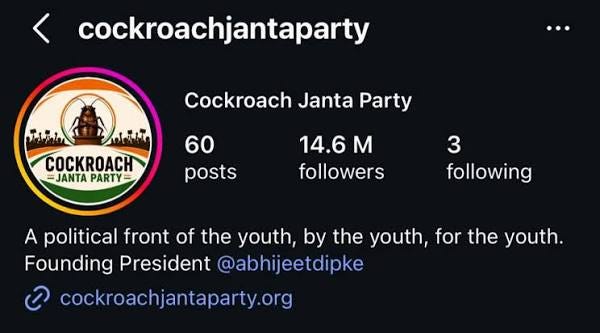
The Cockroach Janata Party (CJP) secured a major victory by getting Dharmendra Pradhan to resign. The government’s position was untenable from the start and Dharmendra Pradhan has been lacklustre even in the Petroleum Ministry. Once calls started for Pradhan’s resignation, the government should’ve booted him out.
Be as it may, the government chose to wait for over a month and only then capitulate. The resulting loss of face has given (well-deserved) joy to their political opponents. The success of this movement will likely catapult the convenors of the CJP into electoral politics. It would be interesting to see if they would be successful and what strategies they employ.
Throughout this entire saga, I’ve been pondering the impact of this movement on electoral politics, governance and policy-making. So here are some off-the-cuff thoughts on this:
1. Ministers need to stop blaming bureaucrats
A lot of the subtext in the discussion around Dharmendra Pradhan revolved around reforms being blocked by bureaucrats. These excuses surface every time evidence of incompetence of ministers emerge.
And that’s just a lousy excuse. A minister is the executive and the CEO of his entire ministry. The buck stops with him. In the corporate world, no newly appointed CEO would blame his underlings for poor performance during quarterly earnings reports. It would be seen as a sign of incompetence. One of the biggest competencies in executives is their ability to navigate organizational complexity.
Similarly, ministers must be competent enough to bend the bureaucracy to their will. It doesn’t have to be by merely issuing orders. But by also figuring out the binding constraints that make the bureaucracy stand in the way.
For example, most laws in India are skeletons. Actual operative content is made of rules, notifications and executive orders that bureaucracy drafts and publishes in the gazette. If any of these veto points slow down changes in procedures, then it is the job of the minister to figure out why and ensure that bureaucrats don’t face the heat for only doing their job.
2. Institutional capture closed off all release valves
Over the past decade, multiple broadcast news networks have been ideologically aligned with the Modi government1. Anchors ideologically opposed to the current government have had to exit their jobs.
The government has been using central investigative agencies to get legislators from opposing parties to defect and swell their numbers. Over the past decade, the ED has filed 193 cases against politicians, yet has managed to get a conviction in only 2 of those.
Governors in opposition ruled states have been used as a pocket veto to indefinitely sit on bills passed by state assemblies. The Supreme Court ruled this illegal in March 2025 and set a prescribed timeline for bills to be approved or rejected. But on advice of the President, the Supreme Court reconsidered its own ruling and reversed it.
Many NGOs — rightly or wrongly — have faced cancellations of their FCRA licenses. Prominent among these are the cancellation of Oxfam and the Centre for Policy Research. Violations aren’t always publicly specified and this functions as a general chilling mechanism beyond the specific organizations targeted2.
While institutional capture does give the government an advantage, it closes off all release valves. When news debates turn into bashing the opposition’s spokespersons, it makes students feel ignored.
And instead of being the last resort, turning to the streets becomes the first resort of protestors.
3. The breakdown of cities has contributed to the general dissatisfaction
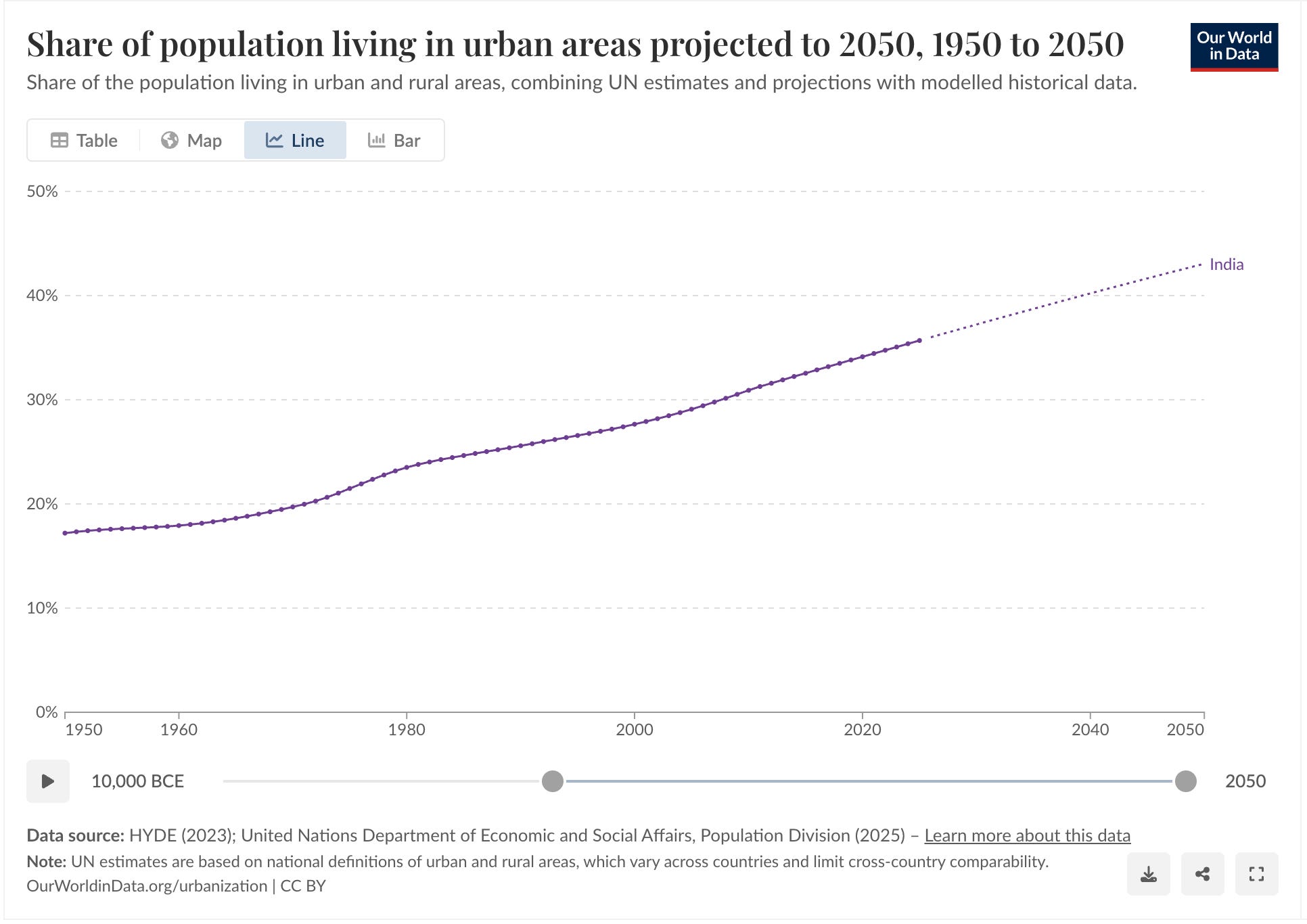
India is urbanizing rapidly. According to the World Bank, about 36-37% of people live in urban areas. But India’s own finance ministry puts it at around 63%. Whatever figure you choose to believe, it is evident that urban infrastructure is on the verge of breaking down.
Out of the 100 most polluted cities, India has 84. Air quality is abysmal and PM2.5 pollution is nearly 10x the recommended limit by the World Health Organization (WHO).
Bengaluru is the world’s second most congested city, behind Mexico City. Pune, Mumbai, Delhi and Kolkata all sit in the global top 10. No other country has this many congested cities.
Encroached lakes and clogged drains ensure that streets turn into rivers every monsoon. Uncollected solid waste piles up, creates mountains and suddenly collapses one day, taking with it an entire building and killing about 8 people.
Pessimism about cities is concentrated in the exact demographic that cares about NEET and other national tests. And this could be another likely trigger that caused the protests to swell up.
Fixing cities is a topic for another day. But I have a feeling that fixing urban chaos would go a long way towards making life in India feel less like a Final Destination scene.
4. GDP growth really needs to kick in
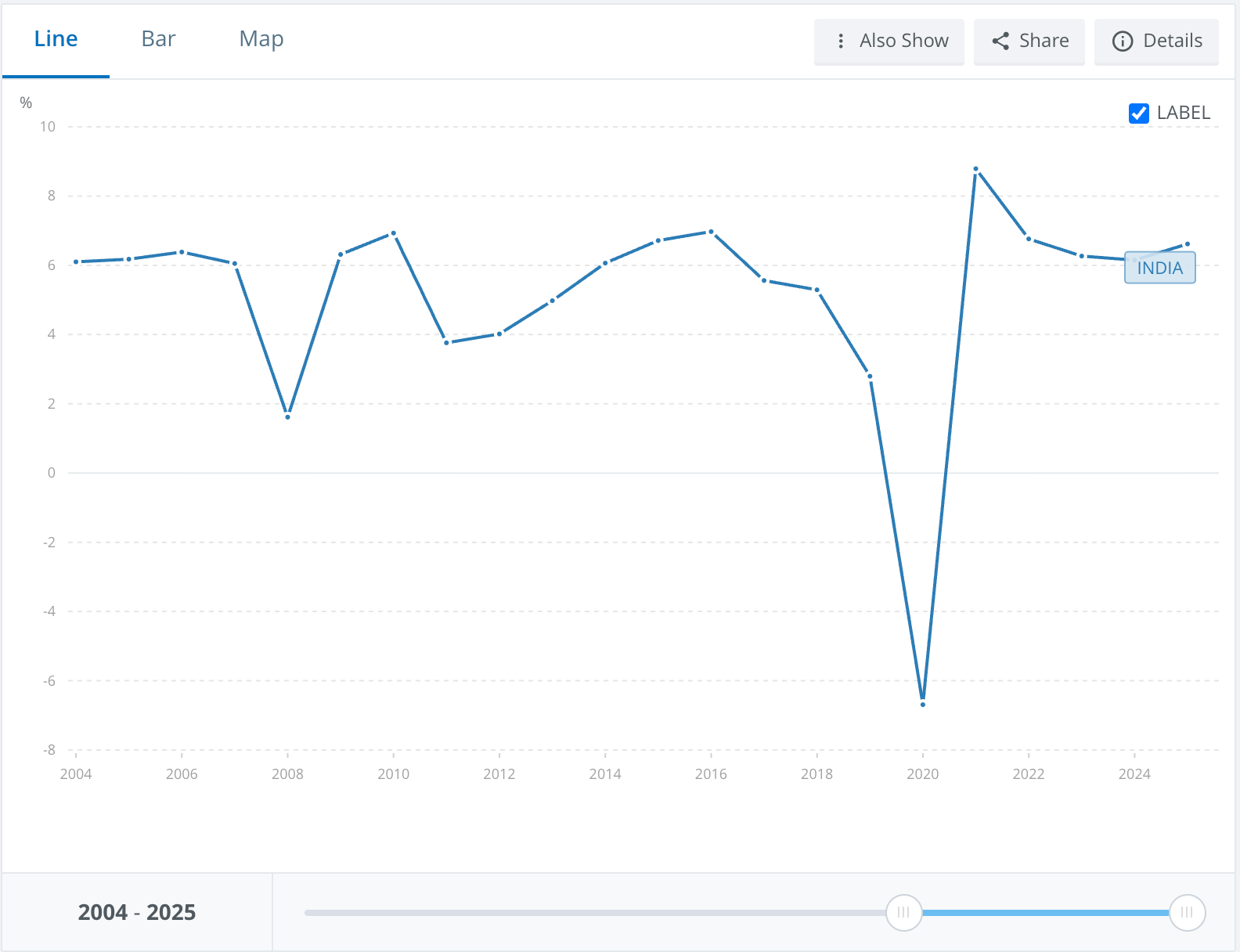
India’s GDP per capita is growing at about 6-6.5% a year. While not bad, it is certainly not fast enough. China grew above 10% for almost a decade. Unfortunately, the international environment of tariffs, combined with the Iran war has likely depressed economic growth for at least a year.
There are still other ways that the Indian government could put growth into higher gear, simply by being more reformist and free market. That would allow the economy to deliver higher growth when the global environment is more favorable.
Low economic growth is anathema. Even if people aren’t able to understand economic growth through numbers, they can understand the vibe of the economy. And no, there’s no such thing as jobless growth. GDP growth means growth in the output of an economy. Output increases when either capital is producing more or labor is producing more. If labor is producing more, more often than not, it is because:
Existing labor is more productive.
More labor is being added to the workforce.
Both of these things mean more money in the pockets of laborers. And that makes many things easier to bear.
When an economy is unable to generate enough high-paying, quality jobs for the workers joining the workforce each year, the dissatisfaction will spill onto the streets.
5. The Modi government must reform agriculture
If you haven’t yet done so, go read my post on the Agriculture Theory of Everything (ATOE).

Most of the problems in the Indian economy can be traced back to the dominance of agriculture in policy makers’ minds. For instance, the National Education Policy (NEP) published in 2020, envisions a future where education is receiving 6% share of budget.
But the problem is obvious: The budget is a zero sum exercise. Allocating more to one sector means taking away from something else. There aren’t many candidates good enough to take away from — except one.
Fertilizer subsidy itself accounts for about 3.5% of the budget. Even more so, the fertilizer subsidy is a regressive one. Because it is a flat subsidy given out for each unit of fertilizer, the bigger farms use more fertilizer and end up cornering a larger amount of subsidy.
Part of the rot in the education sector is also downstream of the extreme high-stakes situations in exams. Seats available for general category have reduced owing to EWS reservations. Major landowning groups like Marathas and Patidars have been downwardly mobile leading to them demanding quotas too. And the downward mobility can be traced back to the anemic agricultural sector as well.
6. It’s worth analyzing why the Congress lost in 2014
I see many folks trying to generalize from the CJP protest to the results of the Lok Sabha elections 2029 and the many state elections in between. This is nothing but the availability heuristic (or recency bias) in action.
I don't know much about politics, but I do know quite a bit about numbers. So let me weave a story about why Congress lost the 2014 election.
Common wisdom tells you that the INC lost 9.3 pp of vote share going down from 28.55% in 2009 to 19.31% in 2014. BJP went from 18.8% in 2009 to 31% in 2014. The 12.2 pp swing is all accredited to Modi. But is that true?
Let's consider the following:
Congress lost almost all of the votes in Telangana/AP. Jagan gained about 14 million votes. INC could get only 2 seats down from 33 in 2009. If the AP/Telangana fiasco hadn't happened, and assuming that INC could've gotten the 14M votes cast towards Jagan, then it would've gotten about 120 million votes which would be close to its total votes in 2009.
In UP, BJP got 42.63% votes in 2014, 49.98% in 2019 and 43.7% in 2024. Yet, its seats continuously decreased from 2014 to 2024. This was because from 2014 to 2024, opposition unity increased quite a bit, such that converting votes to seats required much more effort.
The electorate grew from 717M voters to 834M voters. The 100M+ expansion combined with higher voting turnout from 2009 (58%) -> 2014 (66%) ensured that there were a number of new voters. INC's main fault was the failure to acquire newer voters in enough numbers here. While it protected its vote, it couldn't get targeted acquisitions from the newer vote. But this is mostly a one-time ratchet. There won't be this many new voters again. It was a combination of electorate growth + higher turnout. Electorate growth is decelerating hard. And the turnout was likely higher, because BJP + RSS were able to mobilize turnout in their favor. I dunno if other parties have the cadre to mobilize turnout in their favor even if ground conditions are favorable.
Even though there were a number of scams, corruption wasn't on top of mind of people. There are quite a few surveys on this. Stagnating growth combined with higher inflation was on top of people's minds.
The Modi factor cannot be discounted. I'm simply saying that we shouldn't attribute the entire 12 pp increase in vote share to him. I'd estimate a ballpark increase of around 4 pp in vote share solely because of him. And that's a massive number! Especially because all of it comes from the western and northern states.
But the bigger impact of the Modi factor is simply this: That in a fractured polity with a plethora of regional parties, Modi was the Schelling point for coordinating the anti-incumbency votes. And that shows in the BJP's extremely efficient votes-to-seats conversion.
The same factors that made the INC lose in 2014 might make the BJP lose in 2029, but these factors need to be integrated into any analysis.
7. The BJP conceded to avoid wasting the Monsoon session
While the protests were gaining steam, the BJP quickly announced that Pradhan would be shunted out.
Usually, in protests, the ruling party prefers to wait out protests. Protestors also tend to be funded by ideologies opposed to the government. The expectation is to wait and see if protestors commit any unforced errors. If so, then those errors can be used to turn the narrative against them.
As far as I could tell, the BJP did try waiting it out. They were probably hoping for the protests to include some slogans that would allow the government to paint the protests as anti-national or anti-Hindu. The CJP were disciplined enough to not allow it to get to that. Rather than wait some more time, the BJP capitulated, taking the steam out of the protests.
My guess is that they didn’t want Parliament to be disrupted. During the farm laws, Parliament was disrupted over multiple sessions, yet the BJP didn’t blink. So why did the BJP blink so fast here?
My guess is that the BJP has been laying the groundwork for many bills. The two most important are the FCRA bill and the delimitation bill. FCRA regulates the flow of foreign money into Indian NGOs. The nuances are beyond the scope of this post and we’ll discuss this another day.
But delimitation is the most important of all. Delimitation is important for many reasons. I’ve written about it before. And the BJP has spent a lot of time shoring up support for the bill. In an environment filled with animosity towards the BJP and PM Modi, non-NDA political parties would find it hard to justify support to the government on anything.
So rather than waste political capital on an issue it should’ve never allowed to gather steam, it chose to take the loss of face and work on its larger goals.
8. The BJP is the new Congress
Narendra Modi promised “acche din”3 in 2014. Coming off high inflation, an economy being included in the Fragile Five, and innumerable corruption scams, Modi was seen as an agent of change.
He even exclusively campaigned on economic issues leaving out cultural battles completely. In a campaign address in West Bengal, he specifically appealed to Muslims to vote for him. He said that the Gujarati Muslim is so prosperous that the Hajj quota for Gujarat is always oversubscribed, while the Hajj quota from West Bengal doesn’t even receive applications for all the seats.
Because the INC had ruled since independence, with a few interregnums, he could get away with blaming the INC in 2014 and even in 2019. But going forward, that same trick won’t work.
For newer voters, the era of the INC might as well be history. Anyone under the age of 35 has never voted in a national election that the BJP didn’t win. The failures of the BJP are the BJP’s own. Failure to clean up urban infrastructure is the BJP’s failure, regardless of the investment deficits that they would’ve faced in the decades past.
By subsuming those it once accused of corruption, it has become indistinguishable from the INC in the eyes of many.
The economic record of the BJP has been quite good. Fiscal management has been supreme. But GDP growth needs to be kicked into higher gear. While the global environment isn’t the most favorable, there’s still things that can be done. India faces the cost structure of an advanced economy while still being a low income economy and that affects its manufacturing ambitions. That’s one among many things that can be changed and that are actionable.
9. Rifts between the CJP and Sonam Wangchuk
There’s something curious I observed about the interactions between the CJP and Sonam Wangchuk.
Wangchuk was shifted to the hospital on the 21st day of his fast. Later, he broke his fast after being assured of some promises by the government. And one day later, Pradhan resigned.
Soon after, he posted a 22 minute video defending against allegations of him cutting a deal. And his wife, Gitanjali, posted a tweet mentioning Sanatana Dharma. Her erstwhile allies were somewhat disappointed, from the reactions to the tweet.
I find it curious that rifts emerged so soon after the movement, especially towards a man who gave the platform a moral weight — while the convenors were busy stuffing their faces.
10. The BJP’s political future
On Twitter, I see many writing premature obituaries of the BJP. As I showed above, voter bases are tremendously sticky. Even the various communist parties of India still have a 3% vote share. So for the CJP to make a dent in the voter base is a tall order.
The biggest elections for the BJP are Uttar Pradesh and Gujarat in 2027. If the protests are to make a dent there, then they would be able to hurt it in the 2029 elections. But that’s a big if. Caste equations are tremendously hard to manage in the heartland and adding another factor wouldn’t be easy.
The only way that this could be capitalized is if the youth vote could be mobilized away from the BJP. And even then, it depends on two factors:
It should uniformly get mobilized towards the CJP (or one political party affiliated with it).
The opposition should be united in putting up one candidate.
Even assuming that the youth vote gets alienated from the BJP, if the vote is split among multiple parties and the opposition fails to coordinate, the dividend of that vote would fizzle out.
If the opposition isn’t united, then the problem of Schelling Point remains. Which would be the coordinating person that would receive the most votes? Modi was the 2014 Schelling Point.
All in all, I think this was a good day for democracy. The protestors got their demands heard. The BJP realized that all wasn’t well among the youth of the country. The protests acted as a release valve. The protestors were extremely disciplined and stuck to the pre-decided messaging. Ministers have probably come to the realization that their necks are on the line and even the Prime Minister can’t save them if he wishes to. So hopefully we get better governance.
Before we go, there’s one final puzzle I wish to leave you guys with: Why does the head of the BJP IT cell, Amit Malviya, put out tweets like these.


Are there really people who buy into these kinds of records? I am guessing the answer is yes, there has to be some audience who laps this up. But if there exists an audience that would lap this up, do you really need to put out tweets convincing this audience? And how many people are you turning off through this? Wouldn’t it be better to put out literally (and not figuratively) anything else?
Sometimes by force, but mostly through a marriage of convenience.
This is much more nuanced than I am making it out to be, but for the purpose of this post, this should suffice.
“Good days” for my English audience.
People tend to get way too doomer on twitter about every little slight negative thing. They were doing white pills when the skyroot launch happened and they're now suddenly blackpilling because BJP took the L. Reality is, the general elections are 3 years away and anything can happen in that time. This cjp protest is unlikely to decide anything in the long run, especially considering the bulk of the protests were concentrated around Delhi. The rest of the country only saw some sporadic events.
Regardless, this protest and the way it was handled may have been a major international soft power win for us.
Spot on piece. Closing off pressure valves always backfires. When urban infrastructure breaks and youth job prospects freeze, household frustration builds fast on the shop floor. Top-down political messaging can't paper over missing delivery rails. Over at substack.com/@electoralindex , we map these exact sub-regional discontent vectors. Standard polling flattens youth anger into general noise, but local civic breakdown decides elections. Loved this breakdown!